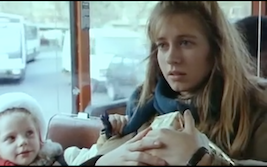
1.Rohmer and Rivette's "Waiting Time," the will to continuity
The camera, which seems to be positioned from the back seat, captures a mother and her daughter in heavy jackets and carrying shopping bags as they board the bus from the front entrance. As they cross in front of the camera and take their seats with their backs to the camera, we see a woman in a hat and a man with long hair sitting in front of them. A bust shot of the mother applying lip balm to her daughter's dry lips and then to her own lips is followed by a similarly sized shot of a man and woman sitting directly across from each other, staring at the mother and daughter. The man and woman's eyes are fixed on the daughter's mother, and the man's expression changes as he seems to remember who the mother is. The woman next to him notices the change in the man's gaze. Just as the man seems to realize that the mother is Charles, his former estranged lover, the shot changes to him again, and a slight smile of conviction appears on his lips. Then, the man made up his mind and said to his mother, "Felicie?" The shot returns to the father and daughter directly across from him. The mother has an uneasy look on her face, perhaps because she suspects that the woman next to the man is his wife. She only replies, "Yes. The man asks if it's his daughter's fault that he hasn't heard from her, and the woman says that she mistook the name of the town she lives in. In this way, the shots moves back and forth between the person who says the words and the subsequent reaction to the other person's response. Watching the man explain the situation to the woman sitting next to him, Felicie, who seems to be getting more and more anxious, get off the bus with her daughter as if to run away as soon as it stops. Charles followed them, calling out to Dora in a panic. Charles says that that girl Dora is just a friend, and he realizes that the daughter Felicie is carrying is the child born to him and Felicie. At this stop, the camera zooms in slightly to bust size to capture the expression on Felicie's face as she asks about Dora and listens to Charles' explanation. The shot then changes to Charles smiling and answering that there is no one there at the moment, and then to Felicie smiling back at him reassuringly, and then to a subtle zoom from Charles' bust to a close-up as he realizes that his daughter is his, as anyone who has seen Eric Rohmer's Winter's Tale/ Conte d'hiver (1992) will remember. In this way, Rohmer has created this scene based on a series of shots turns that capture the movement of a single character as he speaks his lines and reacts to the lines of the other character. Other films in the "Stories of the Four Seasons" series and the "Six Moral Tales" series are more complex and thought-provoking because of this movement. The reason I chose this scene from Conte d'hiver as the subject of my analysis is that it is the scene where the protagonist, played by Charlotte Verey, is "waiting" for her once-lost lover to reappear before her, and he finally does. Regarding this state of waiting, one is immediately reminded of the words of Roberto Rossellini, whom Rohmer admired, "I know how important it is to wait in order to reach a certain state. "(1)
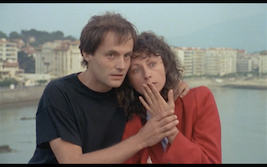
If we focus on the situation in which the protagonist is waiting for something to appear, we can recall Le Rayon Vert/The Green Ray (1986), in which Marie Rivière, who played Dora in Conte d'hiver, witnesses the rays of the sun sinking into the horizon in the last scene. Again, Rohmer's camera subtly zooms in on the couple's expressions and reactions as they gaze at the setting sun on the beach, and interrupts the setting sun to create this scene. By the way, it is well known that this last scene was shot in the Canary Islands, where it was said that it was relatively easy to shoot the rays of light, unlike the other scenes. The reason for Rohmer's use of 16mm film which was obviously going to be even more blurred for this climactic "ray of light," was not discussed at the time of its release, nor is it discussed today. Those who followed Rohmer's statements before his death know that he dared to defend the blurriness of 16mm film against the image quality that would have already been too excessively clear beyond the naked eye for medical use.In other words, Rohmer wanted to leave the existence of the green ray itself, which is indistinct even for a moment, appropriately ambiguous enough to be left to the gaze of the audience. In other words, this is connected to the fact that in Roberto Rossellini's Viaggio in Italia(1953), when Ingrid Bergman is driving the car, it is more important to see her own reactions and changes than to see what exactly fascinates her.
On the other hand, in the scene near the end of Jacques Rivette's to Le Pont du Nord/The North Bridge (1981), which has made the end of his own film even more ambiguous and enigmatic than Rohmer's, there is also a character who is "waiting" for something. It is Marie, a terrorist released from prison, played by Bule Ogier. She comes to the foot of the bridge to ask her ex-lover Julien (Pierre Clementi),who seems to be a member of a mysterious organization, to return the maps and documents that were in the suitcase that Baptiste (Pascal Ogier) switched out. The camera catches Marie walking from left to right in front of the camera. Marie walks around from right to left and right to left as she comes in front of the camera. When she tries to sit down on a bench, we are connected to a full-sized shot. She sits there for a moment, then stands up again and walks around, muttering her determination to "start all over again, to wipe out the past," while the shot continues to capture Marie without interruption. Then Marie sits down on the bench again and says, "The sun is out, but I feel cold. ...... Eventually she notices that someone is coming. The camera, which is connected to the movement, turns in the direction Marie's gaze indicates and captures Julian coming from behind it. Marie walks into that space. The next shot captures the two of them from the side at bust size, and as soon as Marie hands over the map, Julian shoots her with his gun while saying, "I loved you. The next shot shows Julien getting into the car that comes to pick him up, and the camera watches the car drive away.
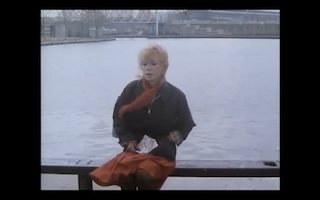
As described above, a scene in Rivette's film is not only the reaction of a person (movement) that Rohmer's film captured, but also the time that encompasses it as a subject. Not only in this scene, but also in Rivette's films, he seems to be saying that if someone is waiting for something to appear, the empty time before the movement to "appear" must be captured "following" the movement. In other words, if it is difficult to follow Rivette's films with the same sensibility as Rohmer's films, which can be followed with a classical cinematic sensibility, it is probably because of the way he depicts this time where nothing happens, but the time that exists with the characters, or the continuity of movement and time.
It should not be taken too easily as a metaphor for the time it takes for Rivette to prepare for one film and the next. Of course, we cannot ignore the influence of the American experimental films of Andy Warhol and Michael Snow, which Rivette himself is said to have seen at the Cinémathèque when he was unable to make films like the other members of the French Nouvelle Vague. But before that, Rivette made a silent short film Le quadrille in 1950, produced by and starring Jean-Luc Godard, which consisted of a few people sitting in chairs waiting for time. "Time" has been his subject ever since. His next short film, Le divertissement (1952), depicts a group of men and women moving through a party hall, which leads to his first feature film, Paris nous appartient(1960). However, while he has chosen theater as the subject of many of his films since this Paris nous appartient, and he has tried to capture when creation was born by the time he made Out One (1971), a massive 12 hours and 40 minutes long in the film era. We have to see what kind of direction Rivette had in mind to make the subject the time necessary to do so. The freedom that comes from a script written by a team of actors just before shooting, which is often the reason for the praise of Rivette's films, is shared only when the audience can accept the structure of time that allows them to feel it above all else. Rivette often says that the reason he uses theater as a subject is because it is work. (2) However, how should we take the expression "work"?
In images, labor, or movement, is documented along with the time that passes. But we should not forget that in our daily lives,movement is generally continuous with the time before it happens and the time of rest in between. Even if the only labor is to be awake at a certain place, rest or sleep is obviously necessary, and the realization of an idea that someone has conceived requires different time structures, pauses, rhythms, etc., depending on the person and the case (notwithstanding the constraints of capitalist society).This is what one labor involves. This is not just the relationship between events and time that a single labor involves. Andre Bazin, referring to the scene of the seal hunt by the Eskimo Nanook in Robert Flaherty's Nanook of the North (1922), says, "For Flaherty, what matters is the relationship between the Nanook and the seal, the actual length of time they wait. While a montage may suggest the passage of time, Flaherty only shows us how the Nanook is waiting. The waiting time of the hunt becomes the substance of the image itself, its true purpose. That is why this scene is shot in a single shot in the film. Who can deny that this scene is much more moving than the "Montage of Attractions"? (3), and "respects spatial unity when the spatial unity of an event is broken up so that reality becomes a mere imaginary representation" (4). However, it is also clear that respecting the spatial unity of a single screen is not enough to capture "all" of the "actual length of time of waiting. In the first place, where can we say that an event begins and ends? The actual scene of the seal hunt on the ice was not shot in a single shot, as Bazin wrote. The scene where Nanook sticks the harpoon in the hole in the ice is already divided into several shots, and the scene where he pulls the rope as hard as he can is also cut and connected. Although the walrus hunting scene in the first half of the film is shot in a single shot, it is captured only for a very short time after Nanook gets very close to his prey, and we can imagine that the time before he gets close, or before he decides which individual to harpoon, is largely omitted.
This is not a point made in light of the fact that CG processing no longer makes it easy to connect the spatial unity of the image with its truthfulness, but it is a matter of course that if you extend the time that encompasses things infinitely, it is impossible to capture all that work in one shot and watch it. This is not to say that "respect for spatial unity" should be abandoned. Even if a series of movements unfolding on the screen cannot be captured on a single shot due to technical and filming realities, it is the staging and editing that demonstrate the "will to continuity" while showing its historical and technical limitations that make the audience recognize the "reconstructed series of time. In other words, it is far more important to show a "will to continuity" while demonstrating the limits in Alfred Hitchcock's Rope (1949), in order to make the audience aware of a "series of reconstructed times," as opposed to the tedious and perfect one-scene=one-shot arrangements of the digital age such as Alexander Sokurov's Russian Ark (2002) or Alejandro Gonzalez Iñárritu's Birdman (2014). Bazin in Forbidden Montage was unable to see the risks associated with the technical limitations of the time in "tightrope walk" in Rope. And the best way that allows us to see this "reconstituted sequence of time" is "theater=cinema" (i.e., documentary of meeting between body in front of the camera and time and space). By the way, in French cinema at the time "What is Cinema?" was written, it was ironically the work of Jacques Becker, whom Bazin criticizes in "What is Cinema?", that showed more than anyone else a "will to continuity" towards a "reconstructed sequence of time", without relying on a "theater=cinema". As with all of his films, Becker's direction and editing of Casque d'oro (1952) and Antoine et Antoinette (1950), as well as Rendez vous de Juillet (1949), with its anthropologist protagonist who seems to have been modeled on people like Jean Rouch, and its take on theater and jazz, heralded the Nouvelle Vague. In Rendez vous de Juillet, Becker, like all of his films, creates a scene as an action that unfolds in multiple spaces and on the street (perhaps the expansion of space made it impossible to produce on a low budget, and thus not a model for the Nouvelle Vague), and at the same time decoupage it so that it can be a continuous time.
2. From La voce umana/The Human Voice to Ford
"Cinema is undoubtedly a microscope, it takes us by the hand and leads us to discover things that the naked eye could not even capture... More than any other subject, La voce umana / The Human Voice (1948) gives us the chance to use the camera as a microscope. The phenomenon to be explored was Anna Magnani." (Roberto Rossellini)(5) First, to document the performances of these incomparable actors, and second, to see their faces up close, not off stage. I wanted to put my eyes in their keyholes and surprise them with my telescope." (Jean Cocteau)(6)
When Jean Cocteau's La voix humaine, first performed at the Comédie Française on February 15, 1930, was adapted by Roberto Rossellini in Paris in May 1947, Rossellini appears to have made no alterations to Cocteau's script or to the stage set, including the room. The film is a monologue about a woman, played by Anna Magnani, who is "waiting" in her room for a phone call from her lover. As soon as she gets the call, she begs him not to leave her. The invisible man on the other end of the phone is going to marry another woman tomorrow. When the phone goes dead, she waits for him to call her again. ...... As is obvious from this description, this one-act play is composed of waiting and movement. Rossellini's camera (shot by Robert Jouillard of Germania Anno Zero (1948) and René Clément's Jeux interdits(1952)) captures Anna Magnani in her room from the beginning of the film without interruption. Of course, decoupage has been done. The first interruption in the series of master shots, which begin with a shot of Magnani's face in the bathroom mirror and follow her movements mainly in bust size, is when we hear the barking of Magnani's black dog and a close-up of the dog is inserted. When she moves from the bedroom to the bathroom, and when she reflects her face in the mirror, they are also connected by a close-up of Magnani. The distance between the camera and Magnani, the body of Magnani lying on the bed after the phone is cut off, and the time that is passing make it possible for the camera-microscope to sense the slightest change in Magnani. When Jean Cocteau shot Les Parents Terribles (1948) from April to July 1948, exactly one year after he had witnessed the shooting of La Voce Umana, he also limited a scene to a one-act play that unfolded in one room (Cocteau's attempt to apply Rossellini's method to his own films, and the episode of trying to shoot in 16mm, etc., are examples of Cocteau's great influence on the Nouvelle Vague). In response to this, Rossellini later agreed with the question, "Isn't what you did the same as what Cocteau did? (5) However, what is lacking in the découpage of Les Parents Terribles is the "waiting time" that Rossellini's film depicts, even though the scene is limited to a single act, or a play in a room. In this "waiting time," the audience is able to get away from the textual information of the dialogue and watch the actors' every move. The "waiting time" is the coordinate for the emergence of more subtle and potentially changing states. In order for the audience to become aware of the more microscopic movements of the figures in the world of image and sound, it is necessary to achieve a continuity of time in order for the movements to become visible. In Rossellini's Viaggio in Italia which seems to have left the "theater=cinema" after La Voce Umana for example, when we recall the scene of Ingrid Bergman playing cards in bed with her husband, played by George Sanders, when he comes home in the middle of the night, we can see the light in Bergman's eyes as she is unable to say a word of reconciliation, even though she says a few casual words. The trembling of the light in Bergman's eyes becomes moving only when the audience becomes aware of this attention to temporal continuity. Or in the famous scene where the couple sees the bodies of the dead couple protecting each other being dug up in the ruins, and wanders off unhappily, they realize that the minute movements of the couple can be seen moment by moment only when the continuity of time is maintained.
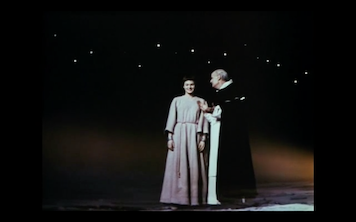
In this way, for Rossellini, La Voce Umana is a film that tests the camera as a microscope throughout the film, making visible the movement on a microscopic level that goes beyond textual information. For this reason, we could say that La Voce Umana needed to pass through the "theater=cinema" as a system that makes the continuity of time a subject. In Giovanna d'Arco al rogo (1954), Rossellini's attempt at a performance in front of camera with Ingrid Bergman, he avoids becoming a live broadcast of the oratorio, and instead of focusing on the reciting faces, he finds the actors' bodies and devices. Surprisingly, like La Voce Umana it was made in the days before the spread of television. In the last years of his life, Rossellini's historical films made for television also explored theater=cinema. For example, at the end of Blaise Pascal (1972), a sick and dying Pascal (Pierre Arditi) lies in bed, "waiting" for communion, saying his prayers and expiring, despite the doctor's assurances that he is not yet dying. The entire ritual is captured, except for a jump cut where the doctor is replaced by a priest. It seems to somehow echo the end of Manoel de Oliveira's Words and Utopia/Palavra e Utopia (2000). The protagonist, Father Vieira, dies "waiting" to be summoned back to his homeland.
André Bazin wrote in "Theater and Cinema" that "cinema saves theater," but unlike the 1950s, today, when there is an overabundance of visual images, we can say that "theater saves cinema" only if the "theater=cinema" does not fall into the trap of being a mere live broadcast that only follows textual information. It is, as I mentioned earlier, the kind of film that makes the audience more aware of the micro-world by preserving the continuity of time, even if it is decoupage, and that does not support the tasteless movement of arrangements to realize one scene or one cut, and that makes the audience feel that decoupage and arrangements are like walking a tightrope full of risks that always break the continuity. In other words, the kind of film that makes us feel that watching the work is like watching the process of its creation. From this point of view, John Ford is not the William Wyler that Bazin exalts, but rather a pioneer of "theater= cinema," comparable to Carl Th. Dreyer in his last period. In the confrontation scene between James Stewart's Lance and Lee Marvin's Liberty Valance in The Man Who Shot Liberty Valance (1962), Lance, a lawyer, slowly crosses the street with his gun in his right hand, looking through the glass at the doctor treating the newspaper's editor-in-chief, Peabody, who was injured by the villains. Then, on his way to the tavern where Liberty Valance is staying, he is approached by some men in town who ask him what he is doing, to which he replies that he is "waiting" for Liberty Valance. Then Liberty Valance, who has just yelled at the sheriff, comes out of the tavern, and a distant night screen catches them both. Valance waits until Lance is clearly visible under the lights, then shoots a bowl of water under the eaves, then waits until Lance is closer and shoots him in the right hand. Then he waits for Lance to pick up the gun with his left hand, and a long shot catches Valance as he triesto fire a final shot. But then he is shot in the opposite direction and collapses, and people gather around him.
The importance of this scene was not the duel between the two men,but how to depict the waiting time. John Ford, who in My Darling Clementine (1946) and The Stagecoach (1939) must have been obsessed with when to insert a shot to show the audience how far apart the dueling men were, simply shot a long shot of the two men facing each other at the same time in The Man Who Shot Liberty Valance. The Man Who Shot Liberty Valance" not only to reveal later that it was not an amateur lawyer who defeated the gunslinger. I think Ford wanted to avoid disturbing the temporal continuity of this scene by manipulating the distance between the two, as he had done in the past. In fact, this scene lasts from the time the doctor tells the people that Valance is dead to the time, Lance returns to the restaurant where Harry played by Vera Miles is waiting for, and Tom, played by John Wayne, sees Harry hugging Lance and goes straight into the tavern to beat up Valance's henchman and leaves. As Harry hugs Lance, the camera moves forward slightly, shaking the frame as it fixes. However, in John Ford's films, which are always based on fixed or moving long shots, and where shaky shots are not supposed to be an issue, what he seems to have insisted on in "The Man Who Shot Liberty Valance," even allowing for such excesses and disruptions, is the continuity of time that is created by connecting cuts. Ford then certainly seems to be approaching a more microscopic, Rossellini-like image. However, Ford's construction of time through decoupage had already been done in his early talkie films before Rossellini. In Doctor Bull (1933) starring Will Rogers, the scene in which Dr. Bull (George), blamed for the spread of typhoid fever in the town, is "waiting" for Joe (Howard Lally) to recover after injecting him with the serum, already retains the continuity of time despite the decoupage. The scene in which George tries to propose to Janet (Vera Allen) is also constructed as a series of moments in time, interspersed with gags featuring Larry (Andy Devine, who played the sheriff in "The Man Who Shot Liberty Valance") and his strong-armed brother with her. Already in this film, Ford continues to film Will Rogers and Vera Allen in moments when they are not speaking, and he doesn't care if they have their backs turned. Long before the advent of television in the history of the world, Ford had avoided using the live action editing of television in his films, where the actors are only responsible for transmitting the verbal information of the dialogue. And we can find the same thing in the beautiful encounter scene between the judge's nephew Jerome (Tom Brown) and Ellie (Anita Louise) on the ladder in Judge Priest (1934) (which Straub-Huillet cites as the position of the woman looking down on the man at the beginning of Dalla nube alla resistanza [1979]), as well as the near-recitation of Henry B. Walthall's monologue at the trial near the end.
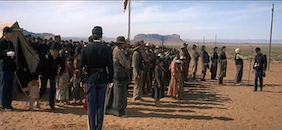
However, although Ford continued to introduce such "waiting" characters and scenes into his films in the 1930s, he backed away from the "theater-film" approach. Perhaps it was because "time" gave the audience room to think, as it did for the classic film, which was soon to be used politically as a tool for war propaganda, for faster storytelling and information, and for manipulating people's minds. Ford's return to "theater=cinema" came in his final years, in the courtroom scenes in Sergeant Rutledge (1960) and in Two rode together (1961). Near the beginning of Cheyenne Autumn(1964), there is a scene in which the Cheyenne people, who have been relocated to a reservation by the U.S. government, gather to petition the Senate delegation that is to visit them for food and water. They stand and wait for the delegation, and eventually the elder collapses from exhaustion, but he continues to stand, brushing aside the hands that try to help him. However, when the people are told that the inspection team is not coming, they start to walk home. John Ford abbreviates the middle of the film by overlapping it, but it is clear that such "waiting" time is the subject of the film. In the following scene, a Quaker teacher, played by Carol Baker, is "waiting" for the Cheyenne children, but their parents refuse to let them learn the white man's language and leave. Here, too, the waiting is depicted as nothing more than a waste of time. But "waiting time" itself is truly important.Then, when the Cheyenne people, who have set out on their journey to return to their reservation but find themselves pursued, begin to prepare for battle, the cavalry send out scouts and the artillery that follows dismounts and begins to fire. ...... Ford describes each battle in its entirety in Cheyenne Autumn. It does not, of course, attempt to approach just a "truth". It is a "staged" battle, as Manoel de Oliveira later depicted in the Alcazar Quivir battle scene in Non, ou A Vã Glória de Mandar (1990). And here, Ford spents time to depict as a continuous movement a series of actions that have been omitted in the battle scenes of previous Westerns, such as how the artillery troops run from the back of the screen to line up/ dismount, and how they hold up their guns and cannons before firing.In the scene where the Cheyenne are trapped in the fort due to starvation and cold, and plan to escape by almost being taken back to the settlement, Sergeant Stanislav Wicevski, played by Mike Mazurki, who has Ukrainian roots, prefaces the scene by saying, "I don't want to be a Cossack soldier killing Poles. This leads to a crazy scene with Karl Malden's captain wandering around with a German accent against a backdrop of dead bodies on the snow that overlaps the war between Germany and the Soviet Union. It is the conclusion of a series of "theater=cinema" in which a military doctor, persuaded by Carol Baker, imprisons Malden, who tries to carry out his orders with the help of alcohol. Also, in the Dodge City scene, a comedic episode in the interval of Cheyenne Autumn, when Wyatt Earp, played by James Stewart, is playing poker in a bar with Doc Holiday played by Arthur Kennedy, and with John Carradine, they are sitting and "waiting" for each other's hands. Meanwhile, Miss Plantagenet (Elizabeth Allen), who claims to be an acquaintance of Earp, and the four men who have killed one of the Cheyenne come in and perform a skit, creating a series of moments that resemble a one-act play. The same can be said of the Civil War episode in How the West was won (1962) and the barroom scene in Donovan's Reef (1963), which suggests improvisation, such as John Wayne and Lee Marvin punching each other on their birthdays. There are people waiting and people coming, and the scene is constructed as a series of time until it begins and ends.
And the conclusion of this one place = theater and one scene = one act is presicely Ford's 7 Women (1965). From the beginning, when Margaret Leighton arrives in an open car in the courtyard of a house with a set that looks like it was set up for a theater, and all the characters appear, each scene (an act) is connected in an orderly fashion with an over-wrap at each interval. In the scene where Cartwright (Anne Bancroft) sees that the Chinese refugees chased by the bandits are suffering from cholera, and tells Emma (Sue Lyon) to move the children, Emma starts walking with the children singing the hymn "Soon to be Far Away," and the camera, which had stopped moving until then, suddenly starts to track back, surprising the audience. It's an extravagant B-movie-like moment, as is the scene where Mike Mazurki and Woody Strode, a pair of Ford movie regulars with pro wrestling experience, appear as Mongolian horse thieves. Considering that the Chinese kimono Anne Bancroft wears in the last scene, predates Elizabeth Taylor's kimono in Joseph Losey's Boom!(1968) (this one with a kabuki motif), I'm almost tempted to say that the final scene, with the stage lights dimmed, is decidedly Brechtian, but even there the sudden trackback, the smallest movement of the image disappearing into the darkness, catches the audience off guard thanks to the retention of continuity.
3, Dreyer, Carmelo Bene, Rivette again.
To capture an unexpected moment in a constructed time. In this sense, Ford's later years are the opposite of William Wyler's films, in which even the scene in which Betty Davis collapses on the floor in The Letter (1940) or Herbert Marshall collapses on the stairs in his chair after a heart attack in The Little Foxes (1941) are too predictable. In contrast, the late Carl Th. Dreyer's films are more than screen-formed documentaries in the sense that their long shots avoid becoming mere set-pieces. First of all, it is easy to imagine that the work of the actors in Ordet (1955) and Gertrud (1964), facing forward but moving in and out of the frame without looking at their co-stars, would be very difficult even for skilled stage actors with few locations. In the final scene of the poet Gabriel's conversation with Gertrud, the woman first sits with him on the couch, and then the man stands up and sits on the chair in front of the fireplace, facing forward. With his long speech, posture, and slow gait, the achievement in one shot seems like a miracle. Of course, the decoupage constructs a one-scene=one-act performance time, but in addition to that, Dreyer's film has an intervening staging that has been used since Vampire, of which directing is that the camera tracing the whiteness of the wall erases the sense of time and space. (In Hitchcock's case, for example, the camera's movement away from the character often has a symbolic role in indicating the imminence of danger) Dreyer's directing of this erasure of the sense of position and time is perhaps can be said to be a precursor of the later scene in Ingmar Bergman's Silence (1963) in which the positional relationship between the sister and the younger sister is undetermined, or in the close-up in Persona (1966) in which a close-up in which the light on Liv Ullmann's face drops rapidly, the change of costume and background during the dialogue in Alain Resnais' L'Année dernière à Marienbad (1961), and the scene in Michelangelo Antonioni's La Notte (1961) in which a woman seduces Marcello Mastroianni in a blank hospital room. Such direction was a possibility at a time when theatrical cinema was a stage for experiments in manipulating the audience's senses through craftsman's labor, long before it degenerated into a race of CG carnage with horror images, from Georges Méliès to Raul Ruiz's counter-criticism of intellectual colonialism. In other words, Dreyer's film was a "theater=cinema" that was simultaneously oriented toward the two poles of the realistic and unrealistic vectors: on the one hand, it was a documentary of the struggles of the actors' bodies, and on the other hand, it was masterwork of theater=cinema that erased the sense of position and time, the coordinates that determine where the body is now.
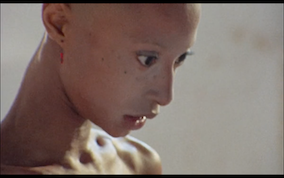
And it was Carmelo Bene in the 1970s who pursued to the limit the method that Dreyer had used in the close-up montage of Jeanne to erase the sense of position and time, while at the same time documenting the actors' performances in the film of performance. The movement and sound of the actors in Salomè (1972) and Un Amleto di meno (1973), etched into thousands of cuts by multiple cameras on studio sets, become a kaleidoscopically re-organized audiovisual music, intersecting and combining light and shadow, red, black, yellow, and green costumes and outfits, the ornamented skin of the naked body, and the microscopic level of the genitals and anus. As the leading figures in Italian cinema in the 1960s Bernardo Bertolucci referred to the aesthetics of Carmelo Bene's first feature Nostra signora dei turchi as “horror vacui”(7). And Marco Bellocchio said that "his genius was above all speed" (8). Bene's montage was a means of escaping the live action of theater and discovering and liberating moments of physical movement from a variety of angles. The reason why such films have not appeared since Bene, despite the lightening and miniaturization of cameras and microphones, is that MTV and commercials, which have replaced film as the mainstream video industry, cannot help but subordinate montage to textual information and music. In this respect, MTV and commercials are nothing more than the heirs to the Stalin-era propaganda to which Eisenstein succumbed. Film as audiovisual music, which escapes the function of propaganda, is sometimes the work of only isolated artists, such as Artavazd Pelechian's films and Klaus Wyborny's especially processed and edited version of footage shot in Super 8, Another World: Song of the Earth II/ Eine Andere Welt. Lieder der erde teil2" (1993-2004) and Etude Studien Zum Untergang Des Abendlands (1979-2010). Such films can only be made with the development of technology. Today, experimental films, whose social status is defined as art, seem to have found a more comfortable home than feature films, considering the spread of their popularity through Youtube and other video sites, and their screening in museums. However, without self-criticism, it is always vulnerable to the ease and danger of becoming an ornament for information manipulation, like commercials or MTV.
Returning to the "theater=cinema" Rossellini's and Ford's will to continuity and Dreyer's vector to the poles were arrows of thought aimed at the works of the new filmmakers of the 1960s, or contemporary cinema. However, in order for the "theater=cinema" to be a contemporary film, it must put itself in danger of being dismantled in order to bring its own form to the consciousness of the audience. Otherwise, the audience will not enter the level of image and sound, and will only recognize the dialogue and textual information, just as in classical cinema. For example, at the beginning of Rivette's Le band des quatre (1991), a theater class student, played by Feilia Duriba, sips coffee in a café, puts on her coat, goes outside, crosses a deserted street, enters a building that looks like a theater, goes up the stairs, enters and takes her position. A girl in a leather jacket and jeans rushes in, and suddenly Marivaux's play begins. .. This should not be possible in reality (what kind of timing is the start of the class? ......), and the audience already from this first scene sees the dangerously real and deconstructed aspects of a single act, or scene, constructed by the film's découpage (the screen of another person is inserted into the previous one, of course, in order not to spoil the continuity). Real time is only a constructed time, and the identity of the characters in front of us can only be inferred from fragments of telephone conversations in which we do not know who is talking because we cannot hear the other person's voice as in La Voce Umana (on the contrary, in Secret Defense (1997) the voice on the phone is not processed into a plausible receiver sound, which serves to expose its fictional nature), and it also contains lies, as in the case of the male character of Thomas, which further places the character and the narrative in a state of non-determinism and finally leaves the audience behind.
The theatrical fragments of Rivette's films can be rehearsals, as in L`amour fou (1969) and Out One noli me tangere(1970), they can be stage performances, as in L`amour par terre(1984) and Va Savoir (2001); or they can be the protagonist's dreams, as in Celine et Julie vont en bateau (1974). Whether it is a dream, a karate lesson as in Le Pont du Nord or a dance as in Noroit (1976), it is part of the same method of showing the bodies of the performers but not providing the audience with information about the performers themselves, that is, the "mystery" in the plot. In order to extract such a time, Rivette also tries to dilute the screen itself and jeopardize its formation. William Lubtchansky's camera moving in Duelle (1976) does not follow only one person as in Raoul Coutard's cinematography of Godard's Alphaville (1965), and does not leave the person and walk alone as in Vittorio Storaro's cinematography of Bertolucci's Last Tango in Paris (1972) and as in the shots of the church scene in Fassbinder's In einem Jahr mit 13 Monden/In the Year of the Thirteenth New Moon (1978)( both are under the influence of the camera leaving the person for no reason in Dreyer's Vampir [8]). Rivette follows two people in the frame, sometimes almost losing them, and in fact we see an aliens (?) played by Bule Ogier and Juliette Berto (Their identity is undetermined.), then they disappear at the end. The young actors in Hurlevent(1985) and Haut bas fragile (1995) seem, at first glance, to be hindering the film with their poor acting and choreography. In contrast to this danger, the only thing that is certain is, yes, the characters and the structured running time. However, if we can see the structure of time in Rivette's film, the audience may be able to contemplate the time of waiting adjacent to the event rather than the event itself, and move away from the immediate reaction manipulated by the popular media.
4, Renoir, Straub=Huillet, the cutting plane
When Jean Renoir made his first talkie film, Laxative for the Boy, an adaptation of a play by Georges Fedor in 1931, he chose to shoot a single character saying and listening to the dialogue, or hearing and saying the dialogue, on one single shot, rather than cutting back and forth between each line in the dialogue scenes, despite the multiple cameras. As discussed at the beginning of this section, it is clear that Eric Rohmer, perhaps learning from Renoir, wanted to capture speaking and listening as a continuous movement on a single shot. However, rather than filming speaking and listening as a set, Renoir was more interested in filming the moment when the action of speaking the dialogue is transferred to the action of listening to the dialogue.
When Robert Ryan and Joan Bennett talk in front of the fireplace in The Woman on the Beach (1947), "If you are possessed by a ghost, surrender and you will feel better," this scene is beautiful because it shows the moment when they move from hearing each other's words to speaking them. When Ryan's face appears on Bennett's face and vice versa, it is also beautiful as a moment of subtle transition. Renoir has truly revolutionized the technique of shot-counter-shot. The same beauty can be found throughout Renoir's work. From the scene in Le Carrosse d'or (1953) where Ramon, Felipe, and the Governor each try to seduce Camilla (Anna Magnani), to the final scene where the director asks her if she misses them all. This is because Magnani is at her most beautiful at that very moment. In the scene where Nan, the housekeeper, condemns Harriet's bare feet in The River (1952), the two seemingly simple turnarounds are so beautiful because Renoir connects them, leaving a moment of microscopic change in their faces before and after they say their lines. Their faces, which might appear ugly in other films, are beautiful because they are captured as moments of movement on a microscopic level. Renoir is also willing to let time and sound jump in order to connect moments of movement that have already begun to the preceding screen. When Valérie arrives and greets her mother, she brushes her hair, but since the first movement is not shown, we are suddenly in the middle of this beautiful movement. The so-called "sensual" moment of Renoir's film is born from the cutting and joining of movements.
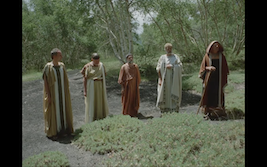
And the "sensuality" of this joining is revisited, for example, in Straub-Huillet's Der Tod de Empedokles (1986). In this scene, Empedocles (Andreas von Rauch), who has been forced to leave his home at the foot of Mount Etna, is confronted by Hermocrates (Howard Vernon) and others who have come to turn him. The distance between Empedokles and the people is not shown there. Even though the editing of their dialogue unmistakably conforms to the shot-counter shot, we can see and hear the autonomy of the two screens and the momentary materiality of the "connected" disconnection, as the rigor of the fixed screen exposes movement at the micro level: sunlight, the bodies of the actors reciting, trees swaying in the wind. Howard Vernon, listening to Andreas von Rauf recite, stands there with a blank expression on his face, without any exaggerated reaction as in Jess Franco's horror films. This thorough restraint has resulted in a combination of voice quality, background noise, and the speed of dialogue at the edges of the shot (most notably in Othon [1969], in which Straub himself quotes Howard Hawks, but not in the 1940s when mixing made multiple voices audible and, dare I say it, the limitations of recording technology I would venture to say that it is close to the sound of Hawks films such as Twenty Century Express (1934) and Ceiling Zero (1936) from the 1930s, when the limitations of recording technology were obvious even to the listener,[10] .) They open the audience's eyes and ears to the presence of images and sounds without using the "Brechtian" technique of deliberately leaving behind cinematographic realities such as crapboard and microphone's frame-in (Renoir's films relate to Brecht (11) only when the audience can take a micro-level view of the cutting plane).
Following Der Tod de Empedokles, Antigone (1991-1992), which can be seen as a critique to Dreyer's Le Passion de Jeanne d'arc (1927) by finding the ground of the amphitheater from an overhead view at all heights and not just from an elevated angle without a background. In Antigone (the film's choruses make us rediscover the native american's gesture in John Ford's Cheyenne Autumn by going back to the prototypes of Greek theater), Straub-Huillet liberates/ rediscovers classical cinema by offering the audience a perspective as a "theater=cinema" that makes audiovisual the "cutting plane" that constructs continuity itself, while Straub=Huillet's Von heute auf morgen (1996) synchronizes the breaks in the opera's musical passages with the breaks in the one-shot and makes the audience listen to them, leading viewers to an analyzing of the structure of classic films like Ernst Lubitsch's One hour with you (1932).Also, by making it possible to look at directing from the perspective of capturing movement at the micro level, we can liberate/rediscover the films of filmmakers such as Resnais, Bergman, and Antonioni who tend to hide the means of manipulation from the audience. Straub-Huillet (and Straub's works after Huillet's death), and their defender and great documentary filmmaker Peter Nestler (for example, In Pachamama unsere erde (1997) when he shows the flow of water from upstream to downstream, you can feel this supreme materiality of connect/disconnect with each changing shot) , and great dutch director Frans van de Staak (Straub called him the heir to the spirit of Dziga Vertov, but even that needs to be considered from a completely different perspective than superficial similarities, etc.), are the ones who, on a micro level, have created an audiovisual disconnect. Today those directors are greatest media-critical filmmakers in the sense that they encourage the audience's senses to grasp the materiality of the medium itself. Their "cutting plane" is not in conflict with the will to continuity mentioned above, for it is a two-sided aspect of "connecting images".
(1) La Politique des auteurs, in Japan translated by Akio Okumura, Libroport, p. 133.
(2) See the interview with Rivette in Jeanne (Kadokawa Bunko), in Japan translated by Susumu Hosokawa, p205.
(3) Andre Bazin,"The Evolution of Film Language" and "What is Cinema?" (above), in Japan translated by Joy Nozaki, Nobuyuki Ohara and Michiaki Tanimoto, Iwanami Bunko, p110.
(4) "Forbidden Montage", same as above, p95
(5) Entretien avec Roberto Rossellini, par Gilles Blain la revue de cinéma, Numéro 45, avril 1966, p. 32-38
(6) Francis Steegmuller, Cocteau: a biography.(London: Constable,1986.) p.474. (7) See the booklet of the DVD of Nostra Signora dei Turchi.
(8) Leaflet of the Festival Thatres au Cinema held in Bobigny in 2009.
(9) Bertolucci: "In the scene where Brando and his wife's mother (Maria Miki) meet for the first time, a moving shot is made against an open door, pushing the characters off the screen. There are many such involuntary movements in "Last Tango in Paris". (Scene Madri, Bertolucci/Enzo Ungari, in Japan translated by Hirohide Takeyama, Chikuma Shobo, p.113)
(10) Entretien avec Eric Rohmer, Cahiers du Cinema n.323-324. There is an excerpt translated in Japan by Hidekatsu Kawatake in Yaso/ Nocturne 11 Nouvelle Vague 25 (Peyotl Studio).
(11) Not only Hawks, Ford, and Renoir mentioned in the text, but also King Vidor of the Pre-Code era (especially The Stranger's return which impressed Ozu), William A. Wellman (although I think he was reevaluated cinematically by Clint Eastwood), and Wyler's A House Divided,etc. As for films of the early talkies in 1930s, now forgotten because of their technical imperfections, should be re evaluated as documentaries about historical limitations and the filmmakers who confronted them in this age of personal filmmaking. (11)For example, Roland Barthes, "Diderot, Brecht, Eisenstein," in L'obvie et l'obtus (extrait) 1982, in Japan translated by Kohei Sawasaki, published by Misuzu Shobo, p. 154.
(First publishing NOBODY45, 2015 summer)
©Akasaka Daisuke