-I think it is really wonderful that Mr. Pelechian came to Japan. It is like a dream that I could meet you.
AP; Yes, I think it is wonderful, too. First of all, I would like to say this - my nature started from the end of this world, is connected to the beginning of the world, which is connected to being in Japan.
-I think your films are the most original work right now, whether they are about the actual universe, as in Our Century (1982), or about a woman's birth, as in Life (1992), they both have a cosmological vision, which seems to start with the movement of particles.
AP; The most important thing for me is the living human being, the mystery, the nature. It's a tiny particle. Nature is creating the mystery while creating man. What film can do is to fix and fix the human movement. And film can create human emotions through montage and other means. It can free us from the hands of time. But unfortunately, it cannot release us alive. But physics and science can help us unravel that mystery. But what is on the screen, even if it is a projection of my own image, is not me.
-There is a motif that Mr. Pelechian always brings up, and that is the light coming through the darkness. Movement is the energy that passes through the darkness and collides with the light....
AP; It's my non-conscious, instinctive thing. You see, I don't really follow the film. A film is like a baby being born. I find the codes and systems of that baby. The organization comes by itself. I just try to help it as a father to it. The organization itself knows where it needs to go better than I do.
-With the movement from darkness to light comes the explosion. AP; That's exactly what it is, it's in all my films.
-The explosion is dangerous, it marks the end, but at the same time, like the galaxy, it is also the beginning.
AP; Yes. This is how I would put it...one explosion is dying and giving birth without knowing what it will give birth to. Another explosion is killing, without knowing who it is killing.
-In Our Century, the explosions themselves constitute a history that is both serious and somewhat funny.
AP; It's like life. The film imitates life. There are conflicting emotions side by side.
-So you think that the eternal movement, where the end leads to the beginning, is a vision of this world as a continuum, a universe?
AP; Yes. You think my film is so interesting and entertaining that you don't need me to comment on it. I like the way you think. Let me put it simply in my own words. When this eternal movement is created, it happens when one particle leaves to the absence and another particle comes to the presence. I think the world is like that. The world is not just made up of what we see with our eyes. There are things that we can see and things that we cannot see that make up the world, and they go in circles around each other. I know that there is a God, but God is invisible. It is in the absence.
-As for the montage of distances, you say that you don't join the two fragments, but pull them apart. It is necessary to separate them because the world is continuous, isn't it?
AP; Yes. In this world, two pieces apart are much more powerful than two pieces next to each other. For example, I believe that all satellites in the universe are created by the method of distance montage. This may seem absurd on the other hand. This is because, after all, "montage" does not mean "joining" but "de montage" = "dismantling". What makes it interesting is not that the beginning is here and the end is there, but that it is more interesting when it is the other way around. It's much more powerful than going from the beginning to the end. It seems to me that there is a different logic in this universe, where there is an end and a beginning.
-The distance=montage allows us to think perpendicular to the time axis instead of along it. It's called erasing time....
AP; Yes. And it creates a reverse time. We are subservient to time. But in the distance montage, time is very weak against it.
-So, for example, you can have the motion of a falling airplane filmed next to each other across time, as in Our Century.
AP; Yes, humanity has always been against time. The pyramids, for example, are also a way to fight time. The ancient Egyptians had a completely different movie. It was only in the 20th century that the Lumiere brothers invented cinema, which fixed the human figure as if it were a corpse. What the movies are doing now is what the Egyptians were trying to do to the Pharaohs. What I am about to say may seem like a miracle, but I believe that when civilization develops film, the process of mummifying a pharaoh can be recreated (in detail) by computer. Then we will be able to see what it was like at that time. Each country, such as Japan and Russia, has its own archives, but for me, archives are "nature". God also has his own archive. With the help of computers, movies will be able to use this archive freely in the future. It will be possible to reconstruct Alexander the Great or Napoleon, or even the conversation we are having here 100 years from now. Nothing disappears from nature. The films of the future will incorporate all of that.
-Please tell us how you came to make The Beginning, which was shot when you were a student.
AP; There was going to be an event to commemorate the 50th anniversary of the revolution, and I submitted a proposal that I could tell the story of 50 years in 10 minutes. They said, "Well, that's some kind of experiment. He said, "I don't know what it will be, but I heard that Pelechian has a good idea, so let's give it a try. I gathered the footage from the archives and processed it. The first thing that came to my mind was "running". I mean, everything is running. I was asked, "Where are you running to?" to which I replied, "You'll have to tell me.”
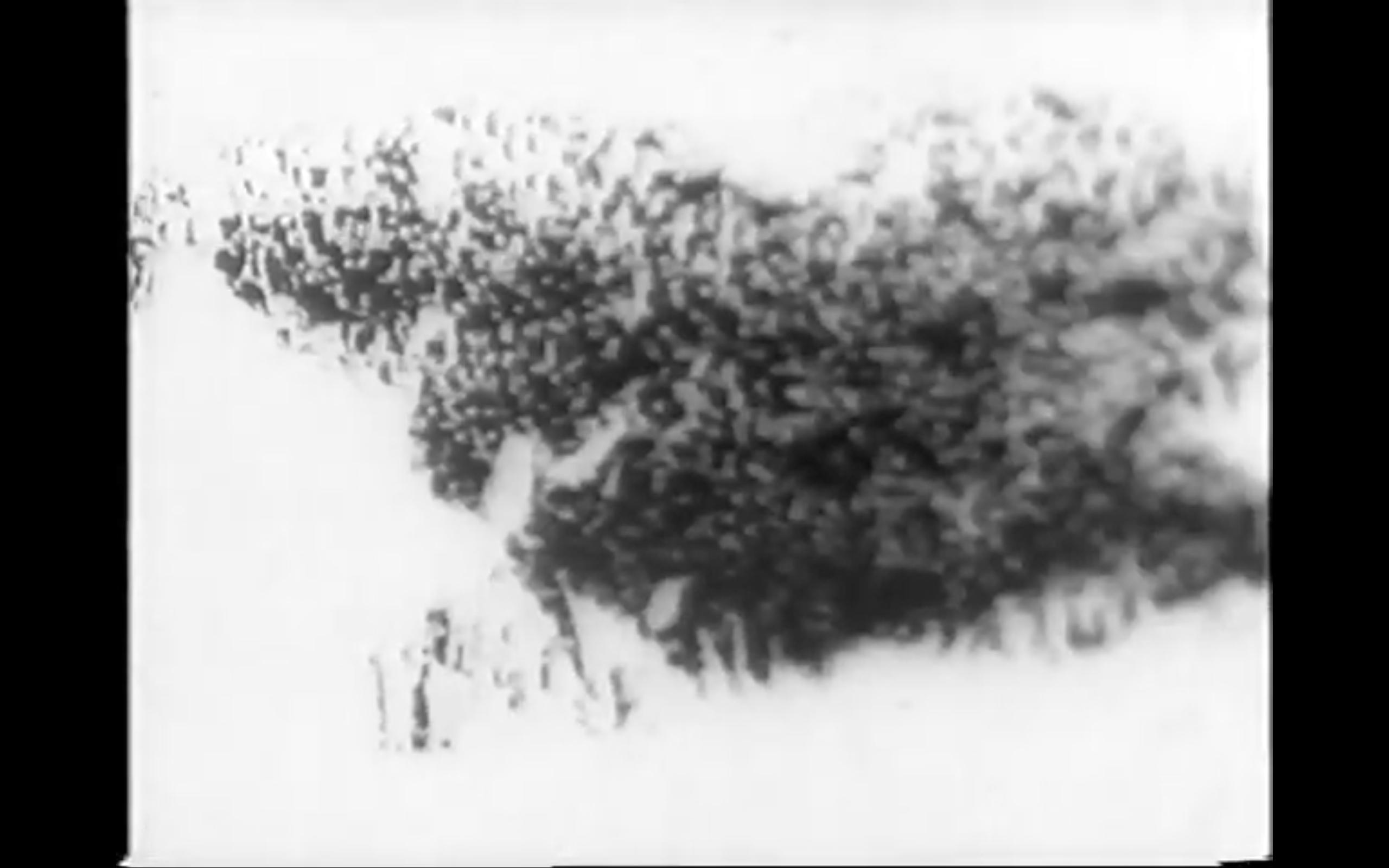
-So, about the "not running" opening scene...the part where you approach the black mass (the shot is coaxial) and you see that it's people, that foretells the vision of all your subsequent films. The people as atoms, or the crowd as a set of particles, is a bit like a (later era) fractal image.
AP; I was earlier than the computer.(laugh)
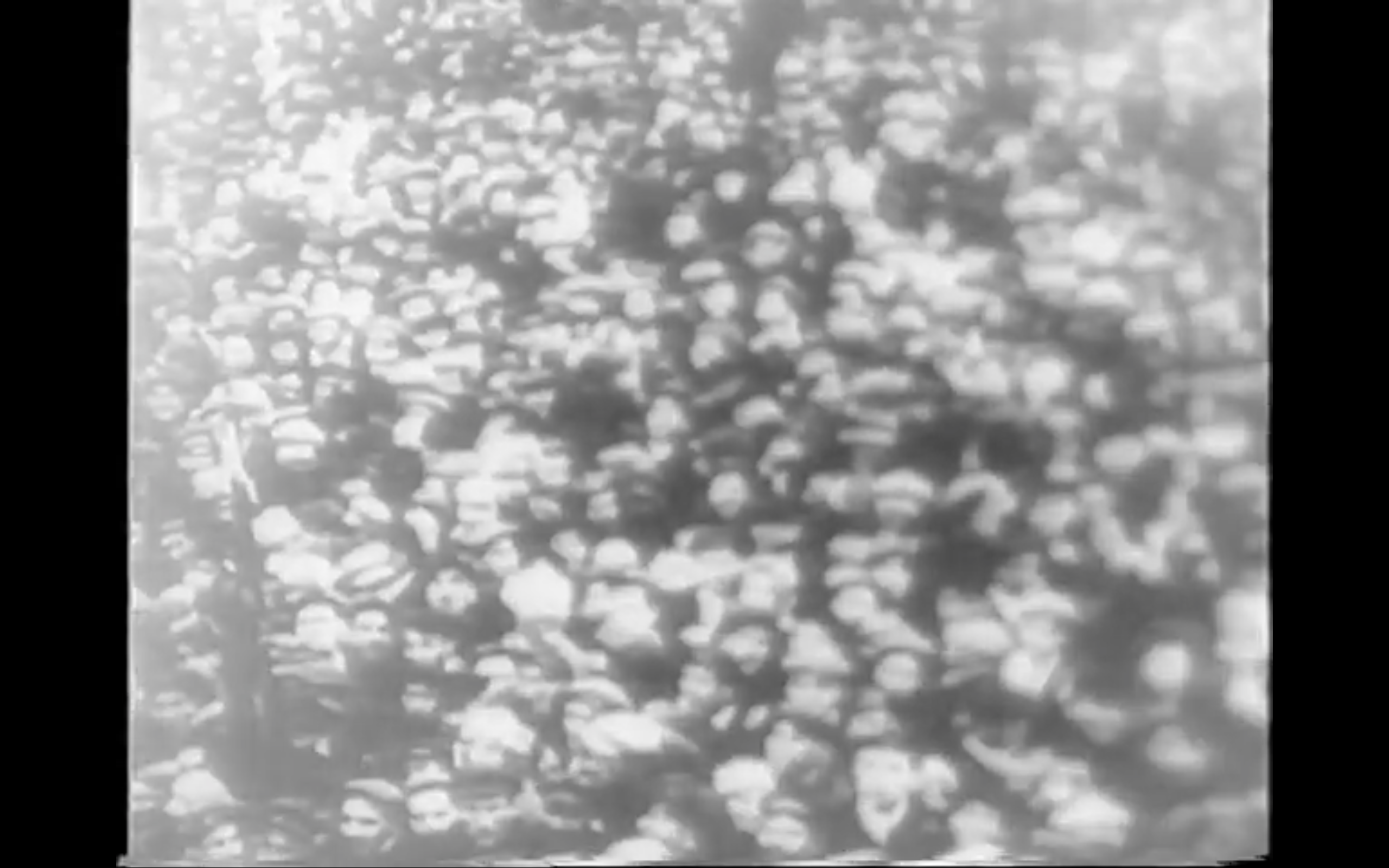
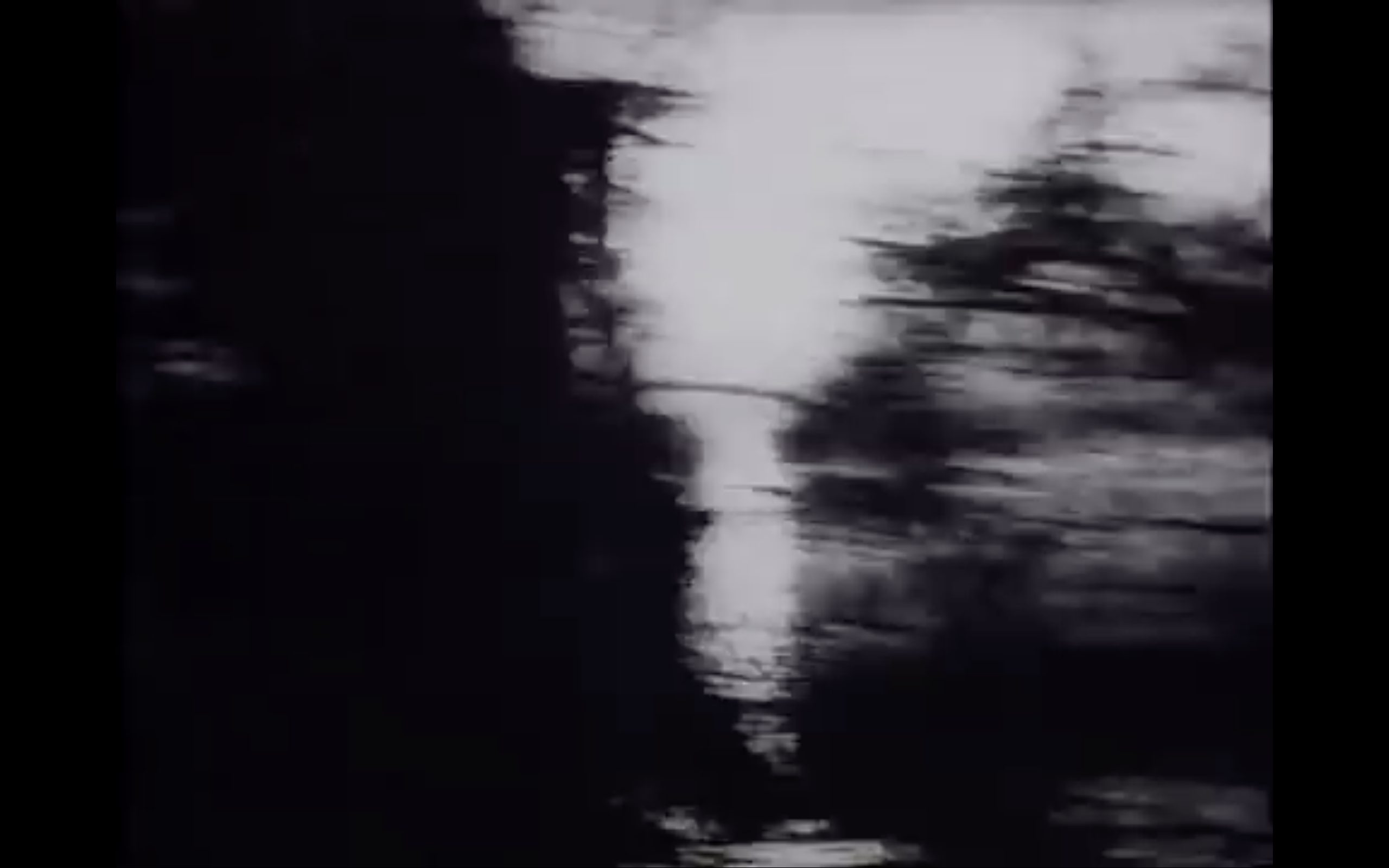
-The contours of the landscape seen through the window of a running train in The End (1992) gradually blend together and disappear, and the black and white birds in The Inhabitants (1970) transform into a patterned movement are wonderful, you have achieved making the invisible visible.
AP; Thank you very much. For me, this "making the invisible visible" is the most important point. Film can not only immobilize the human face, but it can also immobilize our senses. That is the most important position of a filmmaker.
-It's a kind of scientific work....
AP; Exactly, where time moves in reverse, or vertically, as you wish, and time disappears in the first place. It's a new dimension, of course. It's a new concept that cinema can achieve through a "montage of distances”. But I've been working on this for 30 years. So you are (actually) seeing me 30 years ago. This is saying that there is no such thing as time. Time has no meaning in film.
-What do you think now about Soviet cinema of the 1920s, about Eisenstein, Vertov, Dovzhenko? Do you have some idea that you are making films on the basis of tradition?
AP; I don't work on the basis of their tradition at all. If my films remind you of the Soviet film tradition, it's superficial. They are just joining things that are adjacent. They had to evoke some kind of association by colliding two fragments. In my case, I keep my distance and there is no such thing as an association. It's like water flowing in a river. If the traditional Soviet film montage is like "two heads with one body," then my "distance=montage" film is like "one head with two bodies at a distance. These are very different things. They are opposites.
-But don't the films of Eisenstein and Dovzhenko also have the germ of the "making the invisible visible" element?
AP; Maybe they thought about it, but virtually never did. It is thought so for one reason only. What can be seen and what cannot be seen create the development of the talkie. Eisenstein and Dovzhenko were the masters of silent films. When sound appeared in the art of film, they were not ready to use it as much as they needed to. That is why they remained "masters of silent cinema" even in the age of talkies. It has to be the talkies that deal with the visible and the invisible. They just didn't get there in time. Eisenstein saw that Kabuki and Noh made very good use of sound, but they did not realize it themselves. That's because their own montage was joining adjacent ones. In my film, half of the film is absent on the screen.
-Mr. Pelechian, your film is a single audiovisual musical continuum. You also treat sound as an image.
AP; Of course I do. The most important thing to remember is that in my films, sound is image and image is sound. This is despite the fact that we see the image with our eyes and hear the sound with our ears. In fact, it's the other way around.
-In We (1969), there is a voice in the image striking a percussion instrument and in the sound a woman singing an opera. The percussion, the montage, and the rhythms of the opera all have different rhythms and coexist.
AP; Not only that, but there is also "pause. And by "pause" I don't mean the absence of sound, but the "inaudible sound”. So there are more than three, many rhythms in it. And if you add to that the different sounds from the beginning of the film, and join them together at a distance, you can see that there is a very complex sonic process going on. Let's say there are three or four components here. But then there's the opposite process, and then there's another process in the middle, and they work on each other one after another, and they make up a magnetic field. This creates a field of gravity throughout the film. The audience is in the film, but rather than watching it, they are "in” the magnetic field of the film. While other arts function in two ways, time and space, cinema alone functions in three ways, time, space, and the movement of reality. This gives cinema a very powerful weapon. This is what makes it possible to imitate life. In this sense, film is art, philosophy, and science. Most importantly, film can not only create what exists, but also what does not exist.
-Did you study science or engineering before you studied film?
AP; No, I did not. But that was a good thing. It was a good thing, because the different studies didn't interfere with each other. In Eisenstein's case, kabuki might have gotten in the way (laugh).
- By the way, did you collect all the footage for Our Century from the archives?
AP; No, half of it is new footage that I shot.
-There are some scenes with astronauts....
AP; I took the important part, the part of the space flight training and work. The astronauts were very supportive and liked me. They liked my philosophy and what I wanted. They all did what I wanted them to do. They were wonderful people. It was one of the best times of my life.
-How did you come to make The End and Life?
AP; I made them because I wanted to. In my earlier films, I made films about crowds. So now I wanted to make a film about a single person. I wanted to work in an intimate way.
-I heard that you are the "voice" of the Russian version of Godard's Germany Year 90 Nine Zero.
AP; Godard himself asked me to read the Russian narration text for the Russian release of Germany Year 90 Nine Zero. I said, "That's not my area of expertise, and if you need a narration, hire an actor with a good voice," but Godard said I should do it. I couldn't refuse the great man's request.
-What do you think of Godard's films?
AP; I think it's wonderful. He is a great man.
-Speaking of Armenian cinema, did you know Sergei Paradjanov well?
AP; I knew him very well. We were close friends. But let me make one correction. Paradjanov is not only an Armenian filmmaker. Just like Godard is not only a French director. Because they are global figures. Paradjanov is a film of the future. In the future, when we talk about color style and deformation with computer graphics, we must think of Parajanov again. He was a great artist.
-Vladimir Persov (Sokurov's sound engineer) came to Yamagata together. What do you think about Sokurov's films?
AP; I admire him a lot. He is a genius artist.
-Sokurov also told me that he learned a lot from you when he was an assistant on the set of The Four Seasons.
AP; Well that's his experience…
-You have published a book called My Cinema.
AP; It contains scenarios, articles about the theory of distance montage and my films.
-Thank you very much!
(Thanks to translator Kazuko Masamura and Yamagata International Documentary Film Festival 1995)
©Akasaka Daisuke